Why do people run the marathon? I mean really? If the legends are true, didn’t the first marathon runner died after completing a run to ancient Athens? And yet, more and more people aspire to and actually run this race every year. It couldn’t be madness, otherwise there are too much running madmen (or women) in the country already, right?
One can’t help but be curious. Pretty soon you become too curious enough to give it a try yourself. I guess that’s what happened to me this year.
The Milo marathon is on its 26th year already. Though it has been around for that long, for me it has been like going to the moon. I know it’s possible and can be done, but it’s only for the elites and for sure will not happen to me this lifetime. Recently though, long distance running as a sport has experienced a boom and in our office a very active runners’ wellness group has been organized.
Last year, quite a number of my officemates were able to finish the 42 after 6 months of scheduled training. This year, they plan another batch of runners to run and train. As early as February, I declared for my self that I will finish the marathon this year. That’s how it started for me… over lunch while my office friends were discussing about another organized marathon training. No dates were discussed, no specific marathon yet to join.
March came and we knew the Milo marathon will be in July. The more experienced runners in the office were advising me not to run for July, but instead wait for another marathon (QCIM) in December. That would give me more time to train since the training plan is 6-month long. Impatient, stubborn and lazy (three of my best qualities), I decided to go ahead with the July schedule. To wait for December means I need to train for 8 months, besides, I’m fit enough to the marathon anyway… or so I thought.
April came and I’ve only been running short distances on erratic schedule. Far from the prescribed training plan where I should run regularly and with increasing distance; confident that, anyway, there’s still May and June to get serious. Fortunately, I did catch up on my training plan thanks to insistent reminders and run invitations from my training buddy. I did my first long run (15km+) in April and completed my first 32km in June 5.
At 25km, your body will experienced fatigue and it will require much mental discipline to finish upto 32km. That is why they say that once you’ve done a 32km run, you’re ready for the marathon because from 32km to 42km run will just be pure will power.
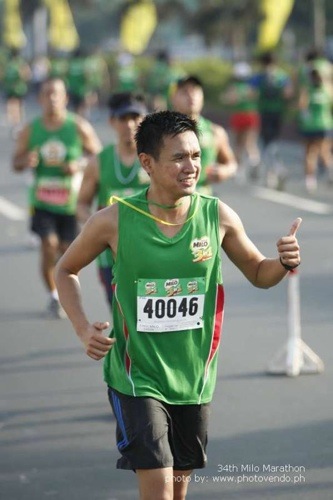
Then July 4 came and it is the Milo Marathon NCR elimination race for the National Finals in December. While the elites and veterans race to qualify for the finals, beginners like me only wish to complete the marathon alive and perhaps finish in 6 hours to get a medal at the finish line.
Good thing is that there were a number of my friends racing on that day for 21km and 42km races. My anxiety and fear of not finishing mellowed down a bit as I met up and chatted with my friends at the starting line. We talked about running together and following this person who paces well (which was only true for the first 15km, after that, it was each person running his own pace).
The race route is 5 loops around CCP-Aseana-Macapagal Ave-Sofitel. Some say the route is boring as it goes around the same area 5 times. For me it was a boon. It was easier to psych myself to run some more everytime I complete a loop.
The first two loops (about 18-20km) was easy enough and quite uneventful. It was just about keeping the pace which is at 8.5kph, enough to beat the 6-hour deadline. My pace group started to break up at the third loop, when each of us started to rest at different rates.
Pretty soon, I was running by myself alone. By this time, you’d start to look for ways to motivate yourself to run some more.
You’d start to look for attractive females to tail-run with. It can keep you motivated to run another 5km straight. Unfortunately, there’s not much of them in the race and they would either be the fit and sexy ones (already ahead of me in the race and hard to keep pace with), the average-paced ones but running with their boyfriends or the not-so-fit ones tailing behind.
And then you’ll meet some friendly guy whom you can chat a bit with how difficult it is to train for the marathon. Then you’ll also meet a friendlier-guy-in-a-weird-way whom you’ll chat a bit but amazingly you’ll find enough energy left in you to burst into a sprint. There’s also your sporty lola runners that, though they don’t intend to, shouts silent insults to your youth and manhood just by being ahead of you in the pack. You’ll again find the motivation to run a bit faster to overtake them.
By the Aliw theater are a group of running-enthusiasts who voluntarily stationed themselves there to cheer everyone who passes by and completes another loop. And just at the turn to Buendia, you’ll meet the P&G volunteers, office friends who are always ready with their Gatorades, menthol sprays and compliments on how great you’ve done running thus far. I was equally thankful for the cheers as well as the menthol sprays because by the 4th loop, my leg muscles became tight and slightly painful due to fatigue. The spray works miraculously to ease the pain for another half-a-loop.
By the 4th loop, it was 40% run and 60% walk for me. But at the 5th loop, it was all walk with a few sprints. It was not much because of my tired feet but because of my acidic stomach. I cannot run 50meters without having a hiccup-attack. Throughout the race I’ve been conscious not to drink too much water and Gatorade to avoid it, but still it happened. Even drinking antacid did not help. I was confident enough to walk as I was in my last loop and with a little over an hour left until the 6th hour deadline.
In the last leg to the finish line, I was just practically walking the race. The sun was scorching that later after the race I would hear the news that someone died because of dehydration. For the last 5km, I tried my best to run for the finish mainly because I soon realized that I miscalculated my time. I thought the finish line is at CCP, but it was in Luneta (about 3km away). I was 3km away from the finish line 40min before the cutoff time, which would have been doable if not for that fact that I have been running for more than 5 hours already for 39km.
I finished with the run time of 6:05. I technically did not achieve the sub-6 (below 6 hours) requirement but fortunately, Milo had some surplus of medals and they were still giving the medals even beyond the 6th hour.
Will I do it again? Probably not. Will I recommend it to friends? Yes, I would. I believe it does build character, the training and the race itself. As for me, I really appreciated the support given by friends for my race preparation and during the race itself, so much so that I vowed to support the runners for the QCIM marathon. My turn to cheer and somebody else’s turn to run 🙂
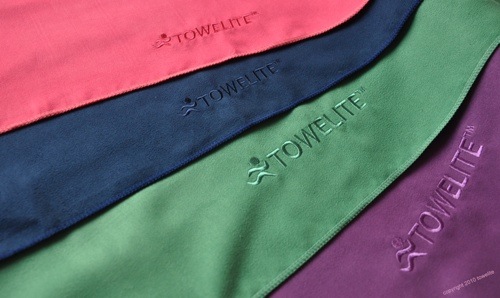
Sometimes you come across a product that is just so useful and different from the rest that you want to share to those you know. And this week, I discovered such a product! I’m actually quite excited to let you know about a brand of high performance towel that is made from ultrafine microfiber. It’s called Towelite!
Towelite has 3 distinct qualities:
compact
You can fold Towelite a couple of times and would just look like a hand towel. It’s handy in a way that you won’t feel the weight of it as it’s just 1/3 the size of a normal cotton towel. One of the biggest hassles and problems that I always seem to encounter is that normal towels are just too thick and inconvenient to carry around especially when you have limited space in your bag or luggage. With Towelite, I think this problem is solved. How cool is that!
absorbent
Towelite is also very absorbent, and considering that it is thinner and lighter than normal towels out there, it’s really amazing to see how much liquid and moisture it can really absorb and hold. It’s like a vacuum that it practically absorbs water up to 5 times its weight! Wow! You might be wondering that it might just absorb about anything including bacteria. Don’t fret as the product has antibacterial properties that inhibit bacterial growth. Pretty cool, I must say.
quick dry
Towelite also dries very fast. You just wring the towel and 90% of the water can be removed from it. Just like magic huh? hahaha! I can actually imagine that the owner should make a pretty good demo in department stores. Remember the demo counters in the mall? I think Towelite is a perfect product for those! A lot of people will be convinced, I’m sure.
Towelite comes in 2 sizes:
24x48in/60x120cm (Php 550) – perfect for everyday bath use.
18x36in/45x90cm (Php 295) – for health buffs who exercise often or go to the gym then this is for you.
I got myself the sports Towelite. I love it!!! It felt weird at first because I was so used to the traditional towels. But really, this is just different considering that it’s not bulky thus very handy, easy to bring along. Plus, when wet, we just need to wring it and 90% of the water will be removed. No need for overnight drying anymore! wohoo!
I love the packaging too! Very nice thinking by the owner to have Towelite put in a useful container. A very unique way to differentiate it from competitors plus Towelite is much cheaper.
A product that has antibacterial properties, can absorb 5 times its weight, light, easy to dry, and can be used over and over again. Just think of the many uses for this product, not just for the health buffs out there, not just for the everyday use to dry yourself off, as well as for bathroom and kitchen use too. A useful product, with innovative materials. Towelite — I wish I had known about this product sooner!
Interested? Contact the seller at the ff. contact details:
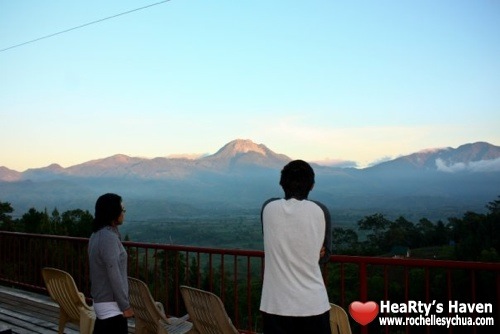
Mount Apo. Situated at Davao del Sur in Mindanao, it is the grandfather of Philippine mountains with the highest peak in the Philippines.
I barely remember why we suddenly wanted to climb this, but a good guess would be as training for the sudden Kota Kinabalu Climbathon. And why are we going to the KK Climbathon? We are adventure seekers a little bit on the daring side but I really don’t know why we go for extremes.
In any case, I like it!
I received the climb invite on April, and with little hesitation I booked my flights. I didn’t catch any promos so the total roundtrip fare took around 4000 Pesos. Once the group was finalized, the preparation was coordinated – itinerary, documents, tips, gear, meal plan, transportation, guides, porters and and other people to contact. Many requirements were handled by our local friend. If you don’t have a Davaoeño friend, I guess you could coordinate with the outdoor shop EDGE.
I’m no ad expert but I think that’s a one-armed headless man on the sign.
Some of us went ahead a night earlier and stayed at BS Inn. It was so-so – very light on the wallet and able to accommodate large groups together. Aside from the lobby, it felt cold and gloomy like a hospital. On the way to our rooms we got to pass sinks filled with unwashed dishes and our beddings were dusty. There was cable TV though and we got to see the opening of the world cup through the diagonally-challenged device. The name of the place was also a conversational piece good enough for a minute of entertainment. Add 30 seconds if you’re good.
Best point:
Cheap!
Worst point:
Cheap!!
You get what you pay for.
But before we went to bed we had dinner at Penong’s (I think?). The food was ok but even though they are still open it seems they weren’t expecting customers past 11 PM. Lots of dishes (even drinks!) weren’t available anymore, the waitress/server took long to attend to us even when we were virtually their only customers left, and the tables around us were unappetizingly unclean.
The rest of the group arrived 5:40 AM the next morning and went straight to fetch us at BS Inn. Sticking to the meal plan, we had breakfast at Jollibee and take-out food for lunch. We went to the Edge store to get some equipment and then stopped by at a Mercury Drugstore for water and some grocery items. Lastly we stopped at the Shell station near the right turn to Kapatagan. You can use this as the last convenience store and toilet break because it’s all sari-sari stores and latrines from then on.
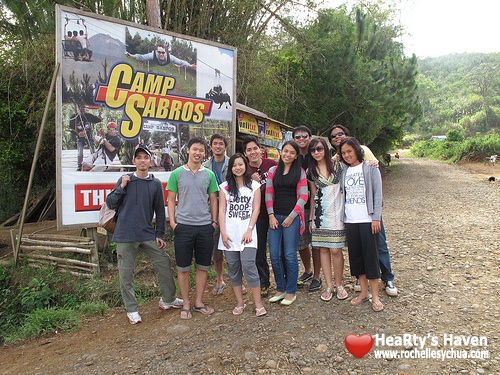
About an hour into the Kapatagan road, right at the Mountaineering Information Center, is the junction to Camp Sabros. Last October all of us were at Davao and Camp Sabros was one of our stops. It was there that some of us got a first glimpse mount Apo, admiring its bald peak with no desire to conquer it. It was also at that trip I first met Rochelle Sy Chua.
Because nobody gave me a copy, this image stolen from Roch’s Flickr!
Didn’t cross my mind that we would be climbing THAT.
From this junction it was an hour and a half of steep, winding dirt roads. All in all, it took around 3.5 hours drive from Davao city to the jump-off point. This was not at the end of the road, nor were there any signs. It was just there – an unmarked, low fence by the side of the road. We handed over our extra baggage to the porters, crossed the fence, and began our ascent.
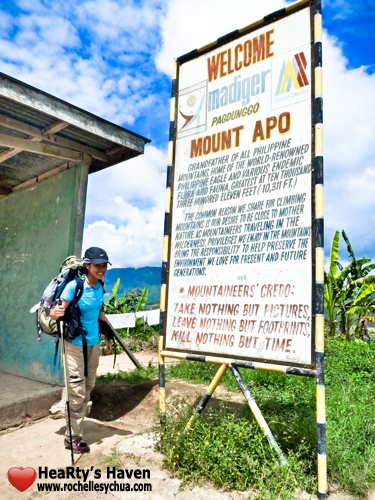
The first 1-2 hours of trail was inhabited grasslands, and there was a lot of garbage on the ground. The trash was a mix of local fare (local junk food like squid rings) and obviously foreign trash (bars, gels, trail food). We were delayed to begin with so we were toasting under the noon sun. Thankfully our jump-off point was already in high altitude and the area was open so there was fresh mountain breeze. We ate our lunch take-outs at the shed by the welcome sign, with a public latrine and some sari-sari stores nearby.
Sorry, I was about to leave something other than footprints.
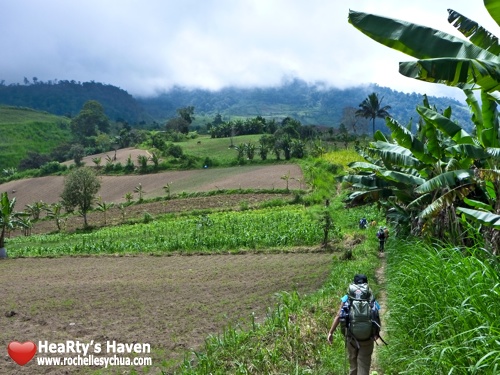
The view was of wide, open fields with banana plants, coconut trees, corn fields, carrot rows, and cabbage patches. There was no electricity in the place and life looked very simple. We couldn’t see past the forest because the mountain was covered by heavy clouds.
The trail here is very easy, just avoid the dung and endure the dense undergrowth deeper into it. It would be good to have your arms covered already. And do take time to greet the locals you encounter – you’re passing through their land!
Easy trail across the inhabited farmlands.
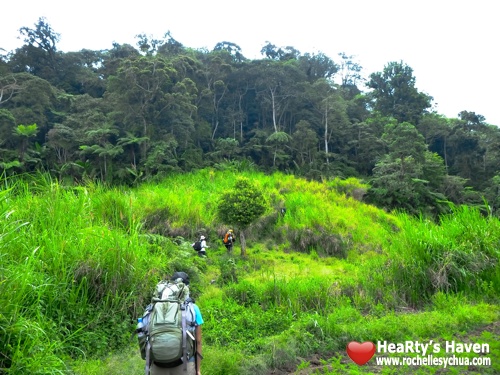
The foliage gets very thick very quick.
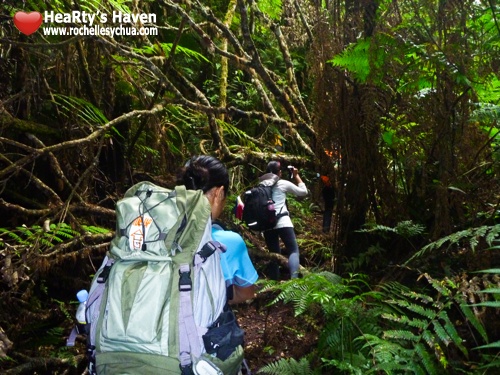
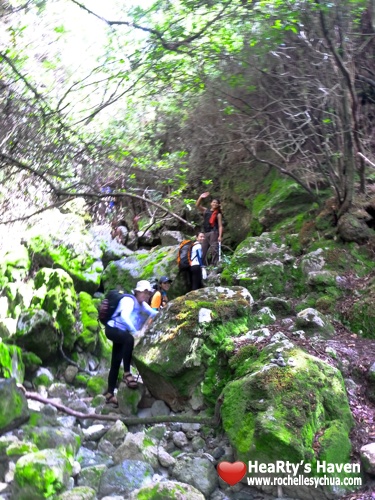
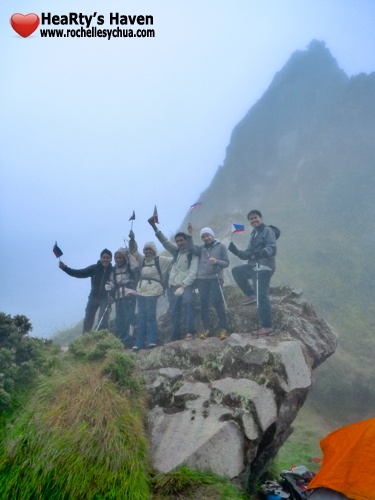
The transition from grasslands to the forest is abrupt. Suddenly the grass is gone, the sky is obscured, and you’re surrounded by trees. The trail got technical from here while leading endlessly uphill. There were lots of spiky plants, trees and vines, and some areas were filled with sticky mud. There were orange flowers, mushroom formations and radiant forest moss for eye candy. There were also birds singing and crickets chirping. Almost no bugs pestered us, just a single bee that seemed to follow us all throughout the trail up even to the summit camp and then back down.
Welcome to the jungle! Watch it bring you to your knees!
An untamed place…but take it respectfully and see that nature is gentle.
The right trail was well-weathered and also marked by yellow ribbons. Be alert and you should encounter at least one every minute around vines, trees and branches. While in the forest it is a good idea to have both hands free or equipped with trekking pole/s. It took us around 2.5 hours upon entering the forest till Tinikaran Camp 1. Plan your time well, and be quick if you’re running very late. By no means should an unfamiliar trekker be caught in the dark while in the forest trail. Darkness quickly descends starting 5 PM. By 6 PM, it gets very cold and there is total darkness.
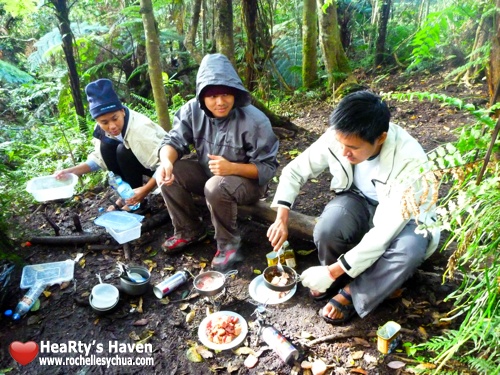
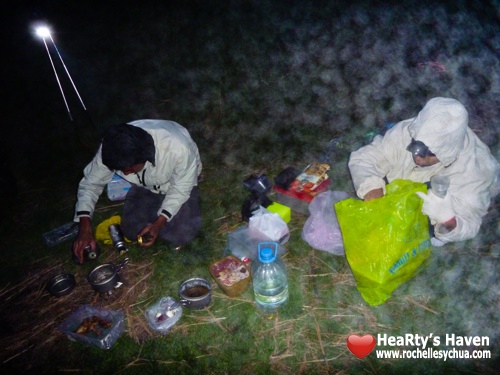
We spent the first night at Tinikaran Camp 1, at an altitude already higher than Baguio’s. We had chicken noodle soup, grilled tuna, boiled cabbage and rice for dinner. We washed the dishes and utensils, entered our tents and tried to sleep at 7:30 PM. You could listen to cricket song and watch fireflies shimmer all around the forest. I just lied down but I couldn’t fall asleep. Especially past 9 PM when it rained.
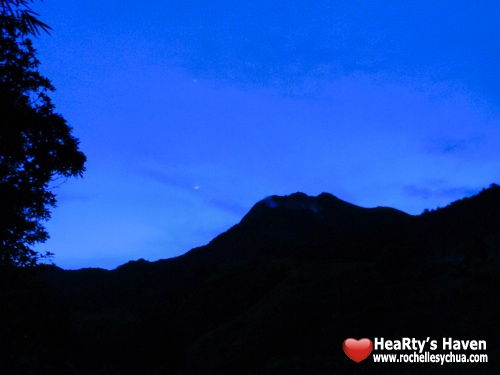
Daybreak at Tinikaran Camp 1.
And boy, did it rain so hard. Our tent was under a tree, but the rain was just so strong. Notice that our tent had no fly. We draped the ground tarp over the top to the back ventilation so the rain wouldn’t get in. Still, the moisture inside the tent condensed so anything touching the tent will get wet. I woke up countless times because my feet were touching the tent. All night there was total darkness even when you open your eyes save for flashes of lightning. There was a marvelous chorus of torrential rain, booming thunder, frogs, birds and crickets. Amidst the discomfort it was an amazing sensory experience. We still woke up feeling fresh the next day.
SPAM came from Survivalist Packed Assorted Meat.
Kidding. It’s actually SPiced hAM (and mystery meat).
Daybreak. We planned to get up 5 AM, but it was still so cold and dark outside. We went out of our tents near 6 instead. We had crackers and bread with SPAM cooked with olive oil. Extra virgin olive oil. Which was actually used in our Pinoy Henyo session. What is it with SPAM that makes it so good? Is it the spices? Or is it the mystery meat? Must be the mystery meat.
Marking the transition from forest to boulders are…boulders in a forest.
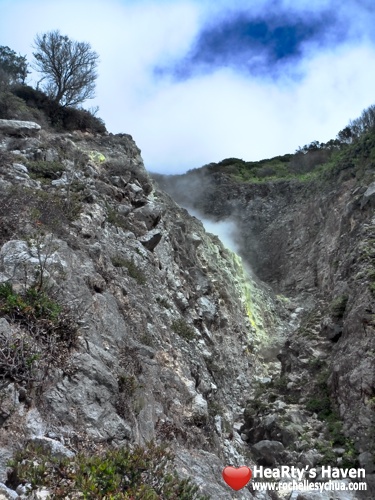
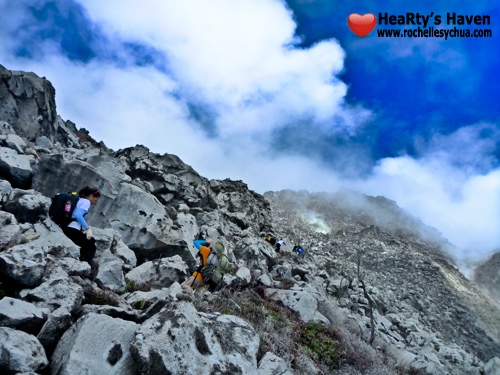
We set out past 8 AM, arriving 9AM at Tinikaran Camp 2 for a quick break. Half an hour later, the forest thinned out as we entered the boulders section of the trail. One of the first sights that will greet you here are the giant sulfur vents. We marveled at it not knowing we’ll be passing so near alongside it. At the worst of times when the wind blows from the direction of the vents, the gases sting the eyes and lungs like diluted tear gas. It is advisable to cover your nose and mouths. No need for goggles. The effects wear off immediately once fresh air blows from the other way.
Aside from the bad gases, the air at this altitude was very thin. I could only manage short bursts of speed climbing before sitting down, out of breath and gasping for air. Rinse and repeat.
Few things are more encouraging than choking on sulfur vents.
The boulders go up to clouds…
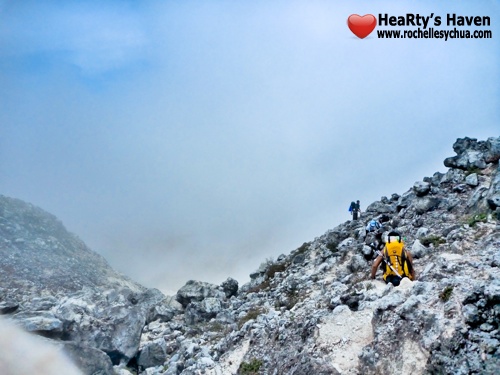
…and up into clouds…
…and up beyond clouds.
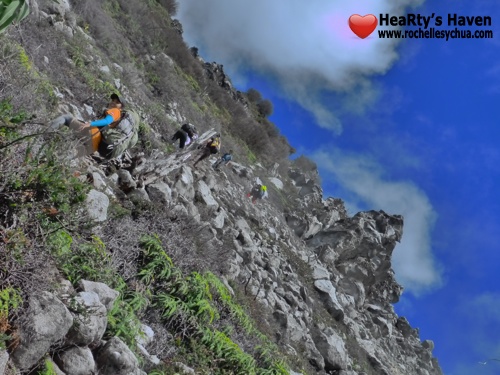
Some parts are a graded slope around the mountain.
The boulders route is marked by sticks with white ribbons and arranged formations of two vertically stacked rocks. You should be able to plot your path to the next marker when you’re standing near one. Please don’t mess these up by taking sticks as souvenirs or removing the rocks. They are conveniently placed just alongside the way to guide trekkers. Don’t try public service by stacking another rock to make the markers more prominent. Three stacked rocks mean “danger.†The trail being naturally dangerous as it is, a “danger†marker should be taken seriously.
How about four you say? Well I don’t know. Just don’t touch the trail markers and leave the arrangements to the experts.
A final rest stop before the ascent to the crater.
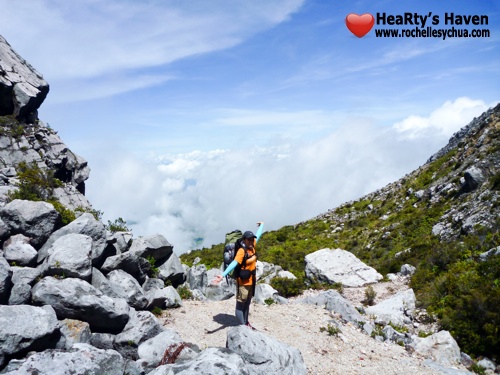
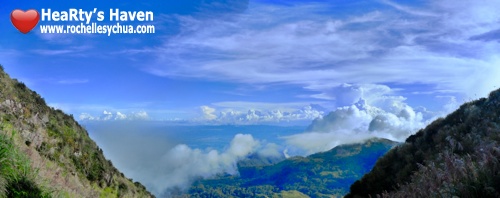
After 2 1/2 hours with 2 rest breaks, we arrived at the final rest stop before the crater. The view here is clear, and at moments when nearby clouds roll out you can see a sea of clouds. The summits were very visible from that point. With the goal so near exhaustion takes a backseat.
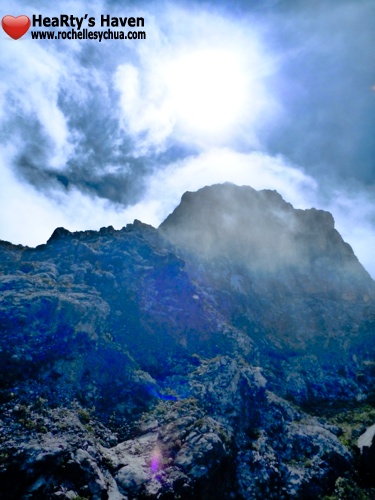
You can see the summits clearly from then on.
The crater was just 30 minutes of steep climb away, on a path strewn with fertile wildberry shrubs. I think I picked more than a hundred of them during that ascent alone. It’s nice morale food and also seems to be a good source of natural sugars and carbohydrates. I didn’t have any tummy complications even after consuming a lot. And I did consume a LOT of it, lingering on the trail and scouring back forth to shamelessly hoard ripe berries. I got so busy foraging I didn’t realize that the crater was only a few seconds away! Eventually the others at the top noticed I was missing and called me up to join them.
I obliged, then all weariness was blown away.
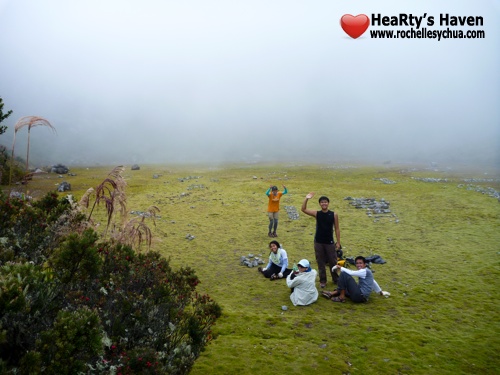
Amazingly wide, flat, clean, soft grassy plain on the dead crater.
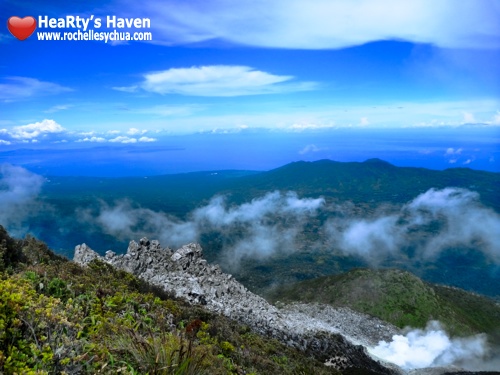
The crater opening overlooks Davao. That’s Samal island at the upper left.
The experience was superlatively wowmazing and photos do not do justice on the scale and magnitude of it. The crater was so wide and perfectly flat, with a floor carpeted by the softest grass. It had Apo’s three summits for walls and a scroll of rolling clouds as its roof. Look out from the crater opening where you passed through, and you could see miles away Davao, Samal island, and beyond to the open ocean. Just. Amazing.
We had lots of fun on the crater. Like energetic little kids let out in the open field, we ran and crawled and jumped and strolled and arranged rocks and rolled around.
After exhausting ourselves all over again, we went up to one of the summits then back down to the summit camp.
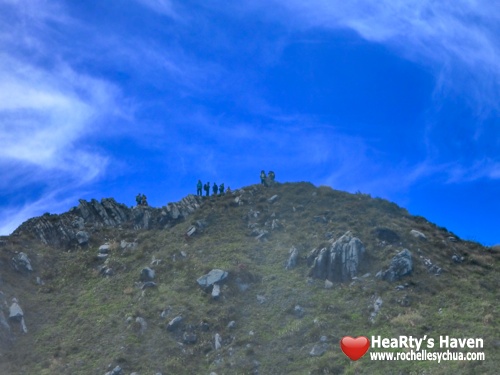
Other hikers at the opposite summit.
Zoomed out for scale. Those are people on the ridge.
This summit camp is a wide stretch of flat land, with tall grass clumps around 2 meters and higher serving as natural dividers between tents and improvised toilet areas. Generations of trekkers have flattened the grass in parcels just right for small groups of people to dwell in. There were even secret pockets completely encircled by the tall grass save for an entrance. And of course our guides, who arrived at the area first, called first dibs to it.
This camp had a water source – a bamboo tube protruding from the side of a dug-out section of the mountain. Where the water comes from I don’t know. I didn’t see any glaciers on top of Apo so I guess it was a natural spring pushed up from below. I hope it comes from below because there was lots of poopie on the camp already.
I should know, because I added to it. Nothing made me feel more like a bona fide mountaineer than that. 😀
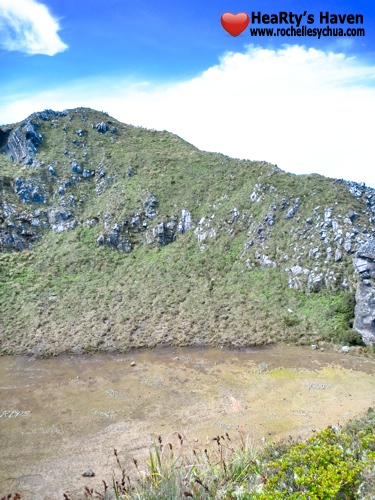
Oh and check out the amazing view from the water source. We were excited about a lake visible just below the photo frame, but somebody said it wasn’t the famous lake Venado. We wanted to go down the trail going through Venado, but our guide advised that the area is currently an active training ground for the “Bagong Hukbong-Bayan†and for safety reasons we should just backtrail. The risk was minimal and these people are apparently good people, but hey, trust your guide – he knows the place and the people and that’s probably why you hired him. Inarguably, we have no business hoppity-hopping over territory they claimed. Maybe next time~
Amazing view from the summit water source
The camp was foggy from 4 PM. The fog was actually clouds rolling over the high ground so I think it’s a whole-day phenomenon for this camp. Nightfall was sharp again, bringing complete darkness and biting cold as early as 6 PM. We quickly prepared dinner and washed the dishes so we can retreat to the protection of our tents. Visibility was just a few meters even with powerful lamps. Unless a bonfire is allowed, there isn’t much you can do outside your tents. Bonfires are not allowed.
Extremely dark and foggy night. This was just past 6 PM.
However cold it was, we were prepared with our thermal gear this time. Full, tired, entertained with Pinoy Henyo and having finally accomplished reaching the mountain’s peak, this was a smoother night to sleep for us. Still, some of us couldn’t sleep and woke others up by talking nonsense around 9:15 PM. Once that was settled, we got back to sleep quickly.
Then the unexpected happened – it rained! We didn’t expect it to rain so hard when we were so high above heavy clouds. Paired with very strong, chilly wind, sleep was near impossible. There was ginormous condensation inside the tent and the wind was knocking it off onto our faces and was just making a big racket. I was weatherproof waist up but my gloves and socks were cotton and I didn’t have thermal wear for my legs. Thankfully the sleeping bags we spread out at as our mattresses were water resistant so the water from below the tent couldn’t reach up and drowned us in our sleep.
Yep, we spread out the sleeping bags to our backs instead of using it to cover our bodies fully. Why? Because we had 2 sleeping bags for 4 people. Why? Ask somebody else!! We barely slept that night, and we even have a video of our ordeal on 1:15 AM.
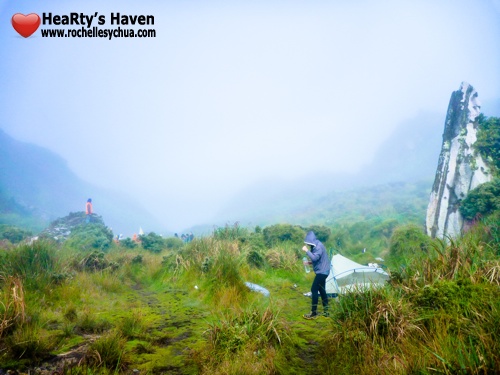
It was crazy. But soon enough the rain stopped, the sun rose up and we were greeted by a very cold, very wet, very foggy morning.
Not really a good morning. This was taken after the worst has passed.
Though the sun was up early, the cold was unforgiving and the temperature outside didn’t get tolerable till around 7 AM. We took our burners inside the tent and heated water there to ease the cold. The air outside was so dense with moisture it was like being in a nebulizer.
Breakfast was chicken macaroni soup, heated canned tuna, canned sausage and cheese spread on crackers and bread – all prepared inside our pleasantly warm tent. We also had hot Milo and naturally refrigerated iced tea. Looking back at the cold, hard night it actually turns to a good experience. That is, once you’ve ensured you and your comrades are alive and kicking.
We packed our stuff, did our final peak photo ops, and began our descent starting 9 AM. The fog was still thick and visibility limited to a few meters but the sunlight was good enough to reveal the trail since 7 AM.
High altitude. Low visibility. No problem.
The atmosphere doesn’t clear till you descend below the clouds.
We split into 2 groups in the boulders. We regrouped and had our late lunch of delicious pork adobo in Camp 1. Afterwards we split into 3 groups that arrived 4:30 PM, 5:00 PM and 5:31 PM at the village at the foot of the mountain.
The descent from the summit was a knee-busting slipfest for me, as I tallied:
9 slips that got me landing on my butt, including one that got me flat on my backpack and wrapping my unprotected arms around a rough tree;
1 bad “tapilok†that thankfully didn’t cause an ankle sprain (I’m prone to ankle sprains especially my right foot); and
At least 4 slips that got me off balance, including 1 that broke the point of my trekking pole, and one that made me grab a spiny tree trunk.
Yep I counted. It was good entertainment to keep score against the nasty trail. My 4:30 PM trekmate, on the other hand, led the pack and slipped only once. Kudos!
Including breaks, our descent from there took 8-9 hours.
We arrived at Davao City 9 PM already. Tired, dirty and battered, we were looking for a good place to stay this time around. Our local friend suggested Legaspi Suites and it didn’t disappoint. We arrived almost 10 PM but the hotel staff was quick to respond to our needs. Their restaurant even took orders for us well past 10. My taste buds weren’t dulled by the mountain air and I’m sure the food preparation was still topnotch. They also offer room service massage, but we were really running late so we passed on that one. Good thing because an expert mountaineer advised against it, prescribing a recovery run instead.
Key points in our stay:
Premier room for 1900 + 600 for extra bed
Nice hotel with an open and breezy atmosphere.
Good location near banks and a convenience store
Courteous, responsive and very accommodating staff
Comprehensive amenities and establishments – restaurant, massage parlor, bar, coffee shop
Room and extra bed rates inclusive of set Filipino breakfast
Spotlessly clean rooms with quality mattress and pillows
Room phone, cable TV, Wi-Fi, hot & cold shower, quality soap and shampoo
Open-air passageway/balcony we could leave our wet shoes on
Taxi ferrying services
No bidet nor ‘tabo’ in the Premier toilet
Filipino breakfast was not excellent
Premier room. 3 staff expertly set up my extra bed in record time.
Dinner at their cozy Kusina Selera. They accommodated us even past 10 PM.
It was only when I was lying down on a modern bed in clean clothes, having had a soothing warm shower and a filling hot meal, that I recounted what we went through the past three days. There is a lot we take for granted among the daily comforts we enjoy in civilization, but we can survive without it. And there is also a lot we are missing by not daring to venture out from our concrete jungles and domesticated vacation spots.
We didn’t conquer mount Apo any more than we conquered ourselves. As fatigue gave way to sweet sleep, I knew the Apo experience was stuff dreams are made of. A story to tell our children. Truly unforgettable.
*RING*RING*…Wake-up call. Sleep passed like a blink of the eye. The breakfast was room service as the restaurant was still closed. We weren’t impressed with the food this time – it was just warm rather than hot, the “hot chocolate†meant a Milo sachet, and they ran out of condiments. The meal was still filling though, and there was little time to be picky. We tried to postpone the taxi trip to steal a few minutes for shuteye, but the taxi was already dispatched to get us.
We got at the airport early but there was no time to loiter because as always, the boarding gates inspection line gets long very quick. I picked up 2 kilos mangosteen fruit, durian yema that is very durian-y, some mangosteen candies, and tuna chicharon. It tastes like meaty pork chicharon, just a hint fishy. I don’t know if it’s “healthier†though. If you’re a health buff you should be found nowhere near deep-fried animal skin.
Alas, goodbye, Mt. Apo. It has been one good adventure.
Want to climb mount Apo? It’s easier than you think and harder than you think. Include it in your prayers and petitions – persevere in prayer all throughout. Get acquainted with reading trails through tutorials and trail runs – there are numerous trail runs organized lately. Build a moderate cardio base, strengthening your core and legs. Be with good people sharing the same passion. Ask for specific tips and guidance from those who have come before you. Finally, get the right equipment, put your heart into the goal, get a good guide, and have loads of fun!
What’s in for you in the Kapatagan trail:
Make your way through a dense tropical forest trail with little worries about leeches, mosquitoes and poison ivy.
Climb, crawl, walk and jump over hundreds of perilous boulders while choking and gagging on gases from the sulfur vents.
Replenish yourself with cool, naturally-filtered mountain water.
Look down over clouds. Touch, breathe, and taste clouds. Like being in a giant nebulizer.
Forage for wild berries fresh from the trail.
Do all your washing with freezing cold water.
Do No.2 in the wilderness!
Try to get enough sleep in a freezing cold, rain-drenched tent.
Stop a slide on the rocks by spreading your arms and then get burnt by covert, little sulfur vents.
Stop a fall in the forest by clinging onto a tree which doesn’t look as thorny as it is.
Have the freedom to risk life and limb on a fast, knee-busting descent.
When the day comes and you are not ready, don’t be afraid to cancel the Apo climb but not the flight – there’s lots you can do in Davao!
——————–
Mount Apo
Davao del Sur, Philippines – 6°59′15″N 125°16′15″E
Do you want to be part of history? Do you love to run? And would you like to help save the Pasig River? If your answer is yes to all the three questions then sign-up in the 10.10.10 run for Pasig River!
10.10.10. Run for Pasig River is brought about by ABS-CBN Foundation as another effort to bring back the glory of Pasig river. Last April 15, they launched “Malinaw” advocacy which aims to achieve a clean Pasig river that is sustainable for the present & future generations. To further strengthen the advocacy, 10.10.10 Run for Pasig River aims to raise fund and awareness for the river. Here is our chance of showing that we filipinos, do still care for our environment. We can run together and show how we can gather together for a very good cause.
The event is targetting 101,010 runners from different groups/sectors (companies, government offices, schools, etc) & this will be the largest run ever organized in the world! We might be able to bag the Guinness Book of World Records for this! Exciting isn’t it?
It will consist of 4 major starting points:
SM Mall of Asia (3Km)
Luneta Park (5Km)
The Fort Bonifacio Global city (10Km) and
SM Markina (21Km)
All runners will converge to one finish line at the SM Mall of Asia where a grand celebration will be held! Wow! I wanna be a part of this! Must be exciting and at the same time it’s really heartwarming too.
Here’s a video where Piolo Pascual shared how ‘Kapit Bisig para sa Ilog Pasig’ is working toward rehabilitating the Pasig river waters. With programs like Materials Recovery Facilities (MRFs), information, education, communication (IEC) campaigns, relocation, and area redevelopment.
So October 10, 2010, let’s save the date! Let’s sign up and create history together! Help save our very own Pasig River. Let’s bring it back to its old glory. Visit 10.10.10. RUN FOR PASIG RIVER to know more about the event & sign up! Be part of the 101,010 runners! wohoo! 😀
Define your personal limits 6,000++ ft above sea level! Join The North Face 100 in Baguio-Benguet. Visit: www.thenorthface100.ph.
That’s a great line, isn’t it? I just wish I could join! I’ve been wanting to run since 2008, I tried joining our beginner’s running challenge for the past 3 years but wasn’t successful. The 1st year, I ended up getting lazy in the latter part. The 2nd year, ended up stopping in the latter part of the year too. This year, I was so determined to run consistently but I got into an accident. The one & only run that I was able to participate was the Nike 10k Human Race. I wish I could do more & I hope the trail running by The North Face will be one. The North Face 100 Trail Running will be on April 24-25, 2010. Experienced runners, trail runners, mountain climbers & those who are seeking adventure will find everything they hope for as tnf 100 traverses unexplored trails of Camp John Hay, the PMA grounds, Mt. Sto.Tomas and Tuba with a fitting finish in the iconic Burnham Park. That’s basically from Baguio to Benguet! I can already think of a lot of colleagues who are up for the challenge! I’m sure they will join this trail run!
There are 4 categories for the Philippine Trail Running:
11k
22k
50k solo
100k solo
Are you game? I bet you are you are! The North Face 100 guarantees to be the longest, most thrilling test of your endurance. Truly exciting, isn’t it? I suggest you don’t waste time and go to North Face branches or go check the site out for details on how to join. I wish I could, but my right foot has 2 bone fractures huhuhu :'(